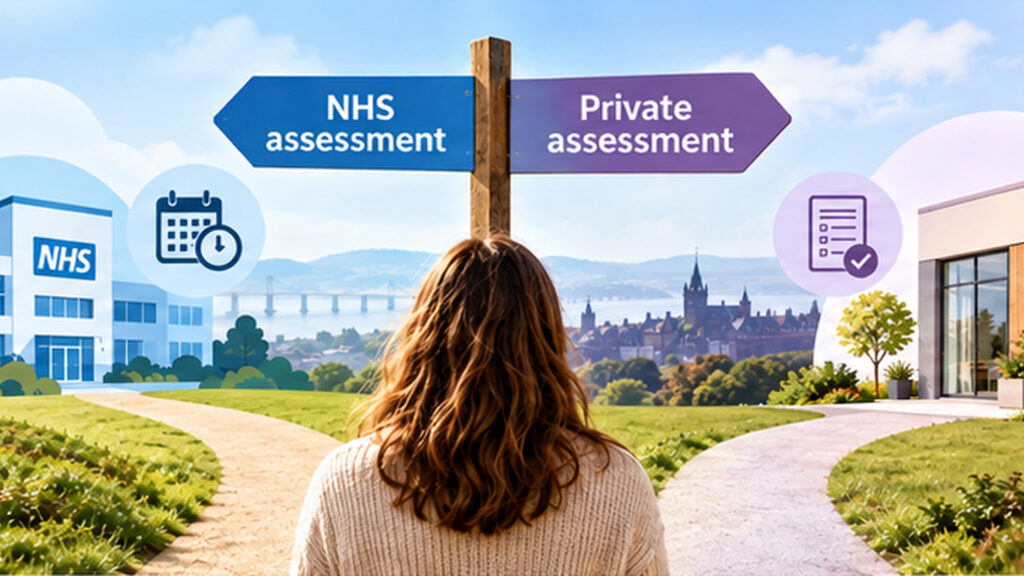
Waiting for an assessment is hard, whether it is for your child or for you. You may be wondering whether to wait for the NHS, pay for a private assessment, or do both. Either route can be a reasonable choice. This page explains how each route works so you can decide what suits you.
How the NHS route works
In Scotland, you usually start with your GP. For a child, a Named Person or a children’s planning meeting can also identify that an assessment is needed.
The Scottish Government has national standards for children’s neurodevelopmental services. They cover children and young people up to 18, and young adults aged 18 to 24. Two points are worth knowing:
- Understanding of support needs should not wait for a diagnosis. A diagnosis can help, but understanding what support a child needs should not wait for one.
- A first appointment should happen as soon as possible, and no later than four weeks after a need is identified. This covers the first appointment only. It does not set a time for finishing the assessment.
For children, the route often runs through Child and Adolescent Mental Health Services (CAMHS). Not every child meets the CAMHS criteria, and some areas have a separate neurodevelopmental pathway.
Adult services are less widespread. Adults who meet the criteria for specialist NHS mental health services (the kind your GP refers you on to) are generally assessed through those services. Others may use a neurodevelopmental pathway, a route for assessing conditions such as autism and ADHD, if their health board has one.
Every health board runs its own pathways, so what you get depends on where you live. In Tayside, the Tayside Adult Autism Consultancy Team is the NHS service for adults with a confirmed or suspected autism spectrum condition. Diagnostic referrals to the service must include a completed screening questionnaire.
As at 31 March 2025, NHS Tayside was not accepting new referrals for neurodevelopmental assessment of children who did not also meet the CAMHS criteria. Adult ADHD referrals went to community mental health teams, and patients needed to meet the criteria for specialist NHS mental health services. Services change, so please check with your GP or NHS Tayside for the current position.
How long is the wait?
Demand for assessments has risen sharply over the past ten years. The Scottish Parliament’s research service puts this mainly down to more people seeking assessment and greater awareness.
When the Scottish Parliament’s research service looked in 2025, there was no regular national figure for these waits. The most recent numbers we could find come from its request to all 14 health boards. At 31 March 2025:
- 42,530 children were waiting (13 boards reported).
- 23,339 adults were waiting (nine boards reported).
- For children, the median wait ranged from 22 weeks to 141 weeks depending on the board. The median is the middle wait when everyone’s waits are lined up from shortest to longest.
- For adults in NHS Tayside, the median wait was 146 weeks. This was the longest median of the nine boards that reported adult figures, and it covered autism only.
These figures are a snapshot, not a forecast. For current waits, ask your GP or health board.
Public Health Scotland publishes CAMHS waiting times, but that report leaves out neurodevelopmental assessments. A child waiting for one will not appear in it.
What private assessment is
A private assessment is one you arrange and pay for yourself, directly with a clinic. Ask the clinic what it needs from you first.
Long NHS waits have led more people to pay for private assessment. The Scottish Parliament’s research service notes that this may cause financial hardship for some. It is a real cost, and it is fair to weigh it carefully.
At Curious Minds, the first step is a free 20-minute phone consultation. You can ask questions and talk through what is involved before you decide anything. Assessments take place in person at our clinic in Dundee.
Our team brings together clinical psychology, nursing and prescribing, and speech and language therapy. We offer six pathways: autism, ADHD, and combined autism and ADHD assessments, each for adults and for children. Current fees are on our booking and fees page. For example, the adult autism assessment is £1,900.
What to ask any private clinic
These questions are worth asking of any clinic, including ours.
- Who does the assessment, and what are their qualifications? Practitioner psychologists and speech and language therapists are registered with the Health and Care Professions Council, and nurses with the Nursing and Midwifery Council. Both registers are public, so you can search them yourself. Ask for names and check them.
- Is it a team assessment? For autism, Scottish national guidelines (SIGN 145, 2016) recommend assessment by a team of different professionals with the right skills and experience. Ask how the clinic does this.
- How is the clinic regulated? Some independent clinics in Scotland must register with Healthcare Improvement Scotland. The rules depend on the kind of service. Ask the clinic about its position, and check with Healthcare Improvement Scotland if you are unsure.
- Will the report be accepted? NHS boards, schools and employers set their own requirements. No private clinic can promise how any of them will respond. Ask the clinic what the report will contain, then ask the organisation what it needs to see. If you are unsure who to ask, we are glad to help you think it through on our contact page.
- Will your GP be told? Ask what the clinic will send, to whom, and with what consent. A letter to your GP is good practice, but your GP then decides what to do with it.
- What about medication? This is where private and NHS care can meet awkwardly. If ADHD medication is recommended, you may want your GP to take over prescribing once treatment is settled. This is called a shared care agreement. There is no NHS Scotland policy on adopting shared care agreements. The GP decides, and some health boards have set their own criteria for accepting private diagnoses. The Scottish Parliament’s research service reports that in many areas GPs do not accept private diagnoses. Ask any clinic about its prescribing and follow-up before you start, and ask your own practice about their approach.
NHS and private at a glance
| NHS | Private | |
|---|---|---|
| Cost | Free at the point of use | You pay |
| How you start | Usually through your GP | Directly with a clinic |
| Waiting | Varies widely by board and age group. Some waits were very long at the last published count. | Varies by provider. Ask about current waiting times. |
| Support while you wait | For children, understanding of support needs should not wait for a diagnosis. | You can ask your school, GP or local services about support while you wait, whichever route you choose. |
| Afterwards | NHS services can coordinate with CAMHS and other local services. | A private assessment is a separate piece of care, so you arrange any follow-up with your GP, school or local services. |
Some families do both. They join the NHS list and also seek a private assessment. That is a reasonable decision, and you do not owe anyone an explanation for it.
Where to go from here
If you would like to talk it through, our free 20-minute phone consultation is a low-pressure first step. You can read more on our NHS vs private assessment page and in the FAQs, or look at the individual assessments: adult autism, adult ADHD, child autism and child ADHD. You can also reach us through the contact page.
Whichever route you choose, asking questions is the right place to start.
Where this information comes from
This page is based on the official and published sources below, so you can read them yourself.
- National Neurodevelopmental Specification for Children and Young People: Principles and Standards of Care. Scottish Government. https://www.gov.scot/publications/national-neurodevelopmental-specification-children-young-people-principles-standards-care/ Published 8 September 2021. Accessed 2026-10-09.
- Neurodevelopmental Pathways and Waiting Times in Scotland (SB 25-25), Ben Adam. Scottish Parliament Information Centre. https://www.parliament.scot/chamber-and-committees/research-prepared-for-parliament/research-briefings/2025/6/24/sb-2525 Published 24 June 2025; data as at 31 March 2025 (Tayside child-referral wording is from the board table, read via the “neurodevelopmental pathways by health board” subpage). Accessed 2026-10-09.
- Child and Adolescent Mental Health Services (CAMHS) waiting times, quarter ending June 2026. Public Health Scotland. https://publichealthscotland.scot/publications/child-and-adolescent-mental-health-services-camhs-waiting-times Published 1 September 2026. Accessed 2026-10-09.
- Tayside Adult Autism Consultancy Team (TAACT), Referral Help System. NHS Tayside. https://www.nhstayside.scot.nhs.uk/WorkingWithUs/ReferralHelpSystem/PROD_380140 Undated page. Accessed 2026-10-09.
- Attention deficit hyperactivity disorder (ADHD) in Scotland: prevalence, treatment and private care. SPICe Spotlight, Scottish Parliament. https://spice-spotlight.scot/2024/09/04/attention-deficit-hyperactivity-disorder-adhd-in-scotland-prevalence-treatment-and-private-care/ Published 4 September 2024. Accessed 2026-10-09.
- SIGN 145: Assessment, diagnosis and interventions for autism spectrum disorders, Quick Reference Guide. Scottish Intercollegiate Guidelines Network. https://www.sign.ac.uk/assets/qrg145.pdf Published June 2016. Accessed 2026-10-09.
- Check the Register. Health and Care Professions Council. https://www.hcpc-uk.org/check-the-register/ Undated page. Accessed 2026-10-09.
- Search the register. Nursing and Midwifery Council. https://www.nmc.org.uk/registration/search-the-register/ Results stated as accurate at 8 October 2026. Accessed 2026-10-09.
- Check if you need to register a clinic with us. Healthcare Improvement Scotland. https://www.healthcareimprovementscotland.scot/inspections-reviews-and-regulation/regulation-of-independent-healthcare/information-for-independent-healthcare-service-providers/check-if-you-need-to-register-a-clinic-with-us/ Undated page. Accessed 2026-10-09.
This page is general information. It is not a diagnosis or medical advice.